Same Highway, Completely Different Planet: The American Road Trip Then and Now
Same Highway, Completely Different Planet: The American Road Trip Then and Now
There's something almost mythological about the American road trip. The open road, the endless horizon, the sense that the country is yours to discover one mile at a time. That feeling hasn't gone anywhere. But just about everything surrounding it? Completely transformed.
Pull back the lens to 1955 and the picture looks almost unrecognizable compared to what most of us pack into the car today.
Before You Even Left the Driveway
In the early 1950s, planning a cross-country drive was itself a serious undertaking. You'd stop by your local AAA office — if you were a member — and pick up a TripTik, a spiral-bound booklet of hand-annotated maps that plotted your route turn by turn. If you weren't a member, you spread a paper map across the kitchen table and traced the route yourself with a pencil.
There was no satellite view. No traffic alerts. No way to know whether the bridge on Route 66 outside Amarillo was washed out until you got there.
Gas stations were plentiful enough, but not every road was. The Interstate Highway System didn't exist yet — President Eisenhower signed it into law in 1956, and construction took decades. Before that, drivers stitched together state and federal routes, some of them unpaved, some of them barely two lanes wide through mountain passes that would make a modern GPS reroute in a hurry.
The Numbers That Put Things in Perspective
A coast-to-coast drive in the early 1950s — say, New York to Los Angeles — typically took two to three weeks if you were being sensible about it. Not because Americans drove slower (though speed limits were lower), but because the roads demanded it. Detours were common. Breakdowns were expected. A reliable car could average maybe 200 to 250 miles on a good day.
Gas cost roughly 27 cents a gallon in 1955. Sounds like a dream until you factor in that the average American household income was around $4,400 a year. Proportionally, fuel wasn't as cheap as that number suggests.
Motels as we know them were just becoming a thing. Before the Holiday Inn era kicked off in the mid-1950s, travelers relied on tourist cabins, boarding houses, or the occasional motor court — quality wildly inconsistent, amenities minimal. Air conditioning in the car? Rare and expensive. Most families drove with the windows down, sweating through Kansas in July and calling it an adventure.
What the Road Looked Like in Between
Here's what gets lost in the nostalgia: roadside America in the 1950s was genuinely vibrant in a way that felt local and specific. Diners were family-owned. The pie was made that morning. You'd pull into a filling station and an attendant would check your oil, clean your windshield, and tell you about the road ahead. Every stretch of highway had its own personality.
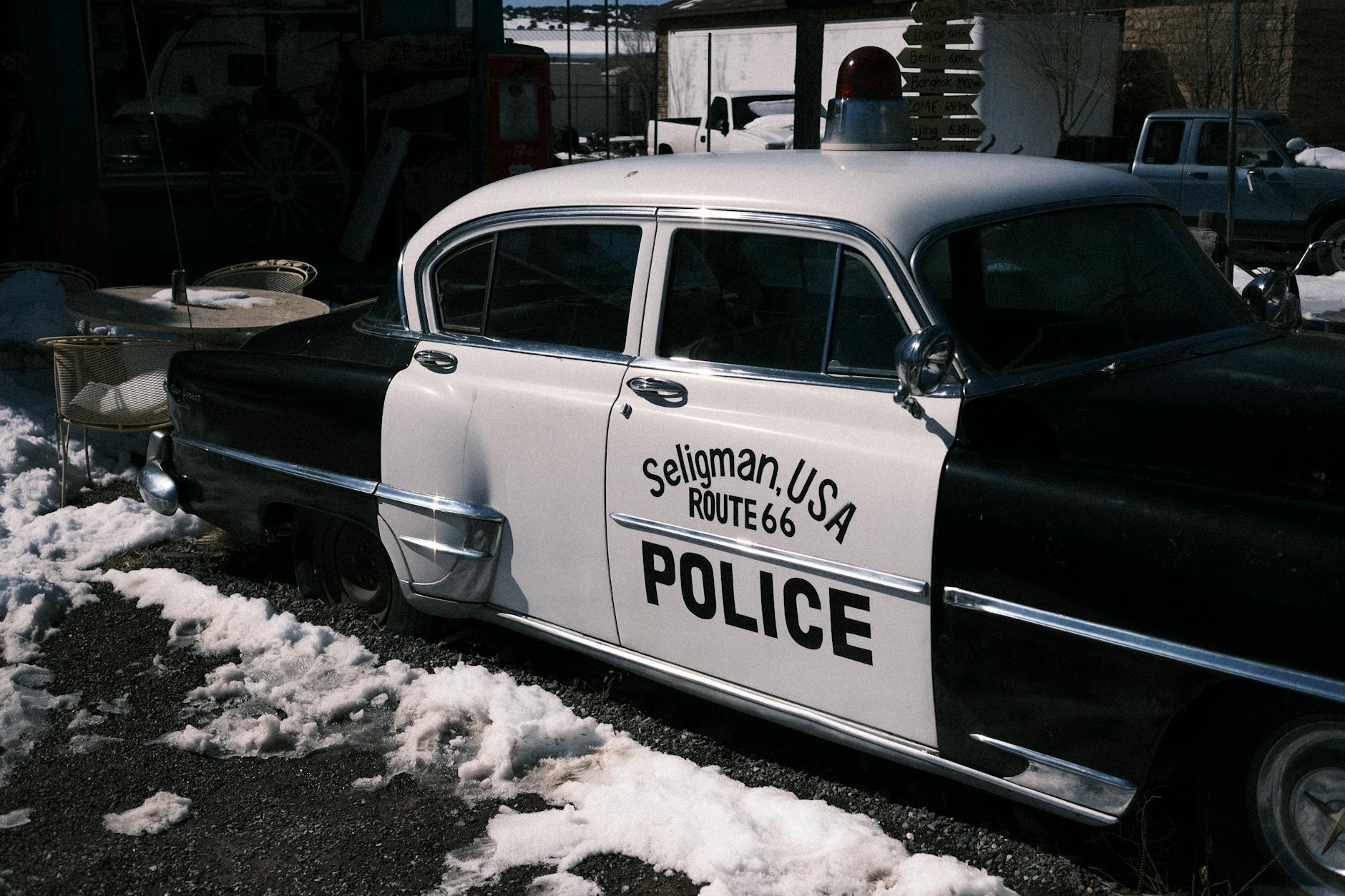
Route 66 — the so-called Mother Road — connected Chicago to Santa Monica through eight states and became the spine of a whole road trip culture. Towns along the way built their economies around travelers. The road wasn't just a way to get somewhere. It was somewhere.
The Modern Dashboard
Fast forward to today and the mechanics of a cross-country trip have been almost entirely reinvented. Google Maps or Waze handles navigation in real time, rerouting around accidents before you even see brake lights. Spotify, Apple Podcasts, and Audible turn long drives into binge-listening sessions. Most new vehicles come with lane assist, adaptive cruise control, and collision warnings — technology that would have seemed like science fiction to a 1955 Chevy owner.
The drive itself is faster. A coast-to-coast trip in good conditions can be done in four to five days of solid driving, or pushed into a week if you want to breathe. Interstates are smooth, well-lit, and studded with service plazas every 50 miles or so. If you're in an EV, apps like PlugShare map out charging stops with the same ease that old TripTiks mapped out motels.
Average gas prices fluctuate, but even at $3.50 a gallon, the modern traveler has something the 1955 driver didn't: a car that might get 35 miles per gallon or better, and the ability to price-compare stations before pulling off the exit.
What Got Better — and What Got Flattened
The honest truth is that modern road trips are safer, faster, more comfortable, and easier to plan. Nobody serious wants to go back to no AC and a busted alternator outside Flagstaff with no cell signal.
But something did shift. The local diners gave way to Cracker Barrel and McDonald's. The motor courts became Hampton Inns. The personality of roadside America got smoothed out somewhere along the way, replaced by a kind of efficient sameness that stretches from coast to coast.
Today's road trip is often curated — plotted on Pinterest boards, documented on Instagram, reviewed on Yelp before you arrive. The spontaneity that once defined the journey has been partly traded for optimization.
That's not a complaint, exactly. It's just a trade-off worth noticing.
The Road Remains
What hasn't changed is the pull. Americans still load up the car every summer in enormous numbers. The road trip is still the most democratic form of travel this country has — no airports, no passport lines, just you and the highway and whatever's on the other side of the next ridge.
Your grandfather would recognize that feeling immediately. Almost everything else, though, would leave him staring at your dashboard in complete disbelief.