Twenty-Four Exposures: When the Cost of a Photo Made You Think Before You Shot
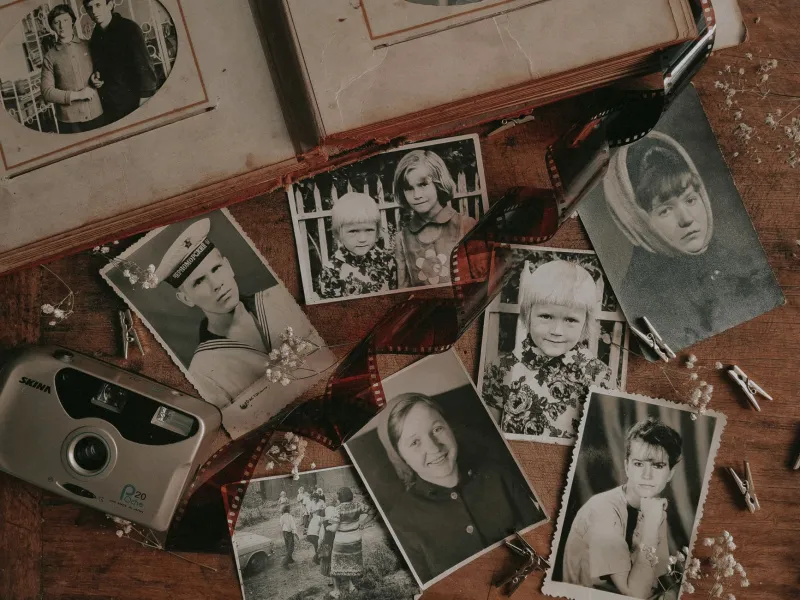
Somewhere in a closet or an attic in most American homes, there's a shoebox. Inside it: a stack of printed photographs, maybe some in envelopes from the drugstore, edges slightly soft from years of handling. A birthday party from 1987. A beach trip that nobody can quite place. Grandparents standing in front of a car that no longer exists.
Those photos exist because someone made a decision. They raised a camera, thought about the moment, and pressed a button — knowing there were only so many chances left on the roll.
That kind of deliberateness is almost entirely gone now. And the images we're left with are both more plentiful and somehow harder to hold onto.
The Economics of Film
To understand what photography used to mean, you have to understand what it cost. A roll of 35mm film typically gave you twenty-four or thirty-six exposures. Developing and printing that roll could run anywhere from eight to fifteen dollars at a mid-range drugstore — and you didn't get to preview anything first. You dropped off the canister, waited a few days, and came back hoping for the best.
Blur, closed eyes, a thumb over the lens — these weren't problems you could fix in post. They were just lost shots. And because every frame had a real dollar value attached to it, people were selective. You waited for the right moment. You told everyone to stop moving. You took one photo, maybe two, and trusted that you'd gotten it.
The result was a natural form of curation. Every roll that made it to the photo album had already been filtered by economics and attention. The pictures that survived weren't just the best technically — they were the ones someone had consciously chosen to take.
The Album as Family Archive
There's a reason photo albums were treated like heirlooms. They were edited documents of a life, arranged by hand, often with handwritten captions in the margins. Dates, names, places — the kind of metadata that doesn't attach itself automatically.
Flipping through a photo album from the 1970s or 80s feels different from scrolling a camera roll. The pacing is different. Each page turn reveals a small collection of images that someone thought were worth keeping, worth printing, worth the cost of a plastic sleeve. You slow down. You look.
Family portraits were a category unto themselves — events planned in advance, often involving a professional photographer and everyone's best clothes. The resulting image would hang on a wall for years, sometimes decades. It was a statement: this is us, at this moment, and we thought it was worth preserving in a way you'd have to walk past every day.
The Infinite Roll
The first camera phone that could actually take a decent picture arrived in American pockets in the early 2000s, and within a decade the entire logic of photography had been inverted. Suddenly the constraint wasn't how many shots you could take — it was how much storage you could afford.
Today, the average American takes somewhere between 1,000 and 2,000 photos per year. Most of those images will never be printed, never be shared beyond a temporary story, and never be seen again after the week they were taken. They exist in a cloud archive that most people couldn't fully navigate if they tried — organized by an algorithm, searchable by face or location, and largely invisible in daily life.
The cost per photo is now essentially zero. And like most things that cost nothing, they're treated accordingly.
What Abundance Did to Attention
There's a psychological shift that happens when something goes from scarce to infinite. The rare thing gets your full attention. The abundant thing becomes background noise.
Film photographers talk about a particular kind of focus that came with the medium — a heightened awareness of the moment because you knew you were spending something to capture it. You weren't photographing everything. You were choosing what deserved to be remembered.
Digital photography, and especially smartphone photography, has changed that relationship in ways that are subtle but real. We now photograph meals before eating them, sunsets while experiencing them, concerts we're technically attending. The act of capturing has started to compete with the act of being present — and presence doesn't always win.
Research from cognitive scientists suggests that the simple act of photographing something can actually reduce how well we remember it, a phenomenon sometimes called the photo-taking impairment effect. When we outsource the memory to the device, the brain may do less work to retain the experience itself.
The Print That Proved It Happened
There's something a physical photograph does that a digital image can't quite replicate. It exists in the world. You can hand it to someone. It can sit in a frame on a mantle and become part of a room's daily life. It can age, yellow slightly, accumulate the small marks of being handled by people who cared about what it showed.
A photo on a phone screen is a representation. A printed photograph is an object. That distinction matters more than it might seem.
Some people are pushing back against the digital tide — the rise of instant cameras, the return of film photography among younger generations, the growing market for photo printing services. There's a hunger for permanence that the cloud doesn't quite satisfy.
Choosing What to Keep
The old constraint of twenty-four exposures forced a question that's worth asking even now: Is this moment worth keeping? Not every moment is. Not every plate of food, every sunset, every selfie deserves a permanent record.
The limitation wasn't just practical — it was a kind of discipline. It made photography an act of judgment rather than reflex. And the images that came out of that discipline had a weight to them, a sense of being chosen rather than accumulated.
We have more photographs now than any generation in human history. Whether we have more memories is a different question entirely.