Before Google, There Was Gus: When Your Barber Was the Neighborhood News Network
The Information Hub That Ran on Hot Towels and Honest Talk
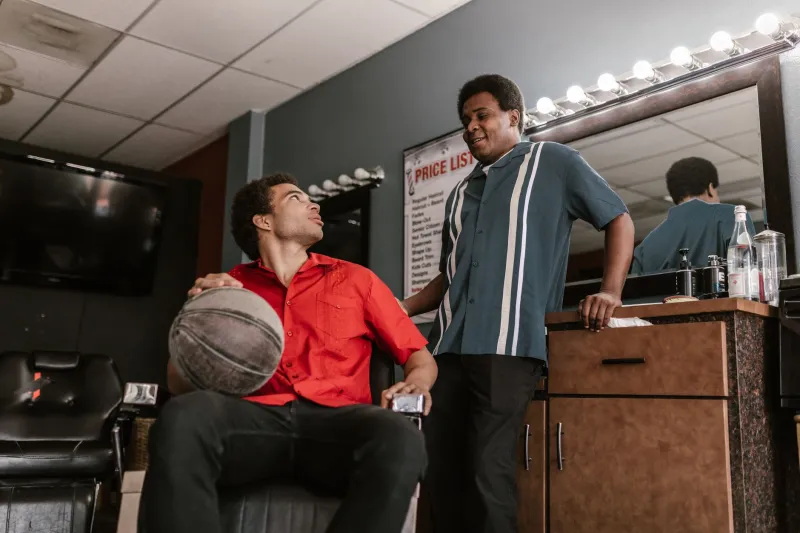
Every American neighborhood had one: the corner barbershop where Gus or Tony or Mike had been cutting hair for thirty years and knew everything about everyone within a six-block radius. Before the internet connected us to the world, the barbershop connected us to each other.
Walk into Gus's place any Saturday morning in 1965, and you'd find something that seems almost impossible today: men talking to each other. Really talking. About their jobs, their kids, their worries, their hopes. The conversation flowed as steadily as the coffee pot that percolated in the corner, and by the time you left, you knew more about your neighborhood than any app could tell you.
This wasn't just a place to get a haircut — it was where information lived, where opinions were tested, and where the social fabric of American communities was woven one conversation at a time.
Where News Traveled at the Speed of Scissors
Before social media feeds delivered breaking news in real-time, the barbershop operated as the neighborhood's unofficial intelligence network. Gus knew who was hiring, who was struggling, whose kid made the baseball team, and whose marriage was hitting rough patches. This wasn't gossip — it was community knowledge that helped neighbors help each other.
The barber served as both information broker and trusted confidant. Men talked while getting their hair cut in ways they rarely did anywhere else. There was something about the ritual — the hot towel, the careful attention, the unhurried pace — that encouraged genuine conversation.
Politics got discussed with the kind of nuance that's impossible in 280 characters. Local issues were debated by people who actually lived with the consequences. National events were filtered through the perspective of men who knew each other's character and could speak honestly without fear of being canceled by strangers.
The Ritual That Built Relationships
The old barbershop experience was designed around relationship rather than efficiency. You didn't book an appointment — you showed up and waited your turn, which meant talking to whoever else was waiting. The barber knew how you liked your hair cut, but he also knew how your father liked his hair cut, because he'd been cutting hair in the same neighborhood for decades.
This continuity created something rare in American life: intergenerational male relationships that existed outside of family. Young men learned how to talk to older men by listening to barbershop conversations. Older men stayed connected to their changing neighborhoods by hearing what younger customers were thinking about.
The physical ritual mattered too. The hot towel treatment, the straight razor shave, the careful attention to detail — these weren't just services, they were forms of care that men rarely experienced elsewhere. In a culture that didn't encourage men to be vulnerable, the barbershop provided a space where being cared for was part of the transaction.
The Digital Revolution That Killed Conversation
Today's barbershop experience reflects how dramatically American male culture has changed. You book online, show up exactly on time, and often find your barber wearing earbuds between customers. The conversation, if it happens at all, competes with phones, screens, and the general sense that everyone's time is too valuable for genuine connection.
The information function that barbershops once served has been completely replaced by algorithms. Why ask Gus about job openings when LinkedIn knows your entire professional history? Why discuss local politics when Twitter can deliver opinions from experts worldwide? Why build relationships with neighbors when social media connects you to like-minded people everywhere?
The modern barbershop visit has become a service transaction optimized for speed and convenience. The goal is to get in and out efficiently, not to build relationships or exchange meaningful information. Even when barbers try to maintain the old conversational tradition, customers often seem uncomfortable with unstructured social interaction.
What We Lost When We Optimized Connection
The death of barbershop culture represents something larger: the loss of informal spaces where American men could practice being human together. The barbershop was one of the few places where men regularly engaged in conversation that wasn't about work, sports, or solving specific problems.
These conversations served functions that our digital replacements can't replicate. When Gus told you about job opportunities, he was vouching for you based on personal knowledge. When neighborhood issues got discussed, solutions emerged from people who actually had to live with the consequences. When men shared personal struggles, they received advice from people who knew their character and circumstances.
The barbershop also provided something increasingly rare in modern life: the experience of being known by someone outside your immediate family. Gus remembered not just how you liked your hair cut, but details about your life that made you feel seen and valued as a person rather than just a customer.
The Isolation of Efficient Services
Modern barbershop chains and high-end salons have optimized the haircut experience in every way except the one that mattered most: human connection. The cuts are more precise, the environments more stylish, the booking more convenient. But they've eliminated the inefficiency that made barbershops socially valuable: the time spent just talking.
This reflects a broader trend in American life: the systematic removal of informal social spaces where relationships could develop naturally. The corner barbershop joined the corner drugstore, the neighborhood tavern, and the local diner as casualties of our optimization culture.
We've gained efficiency and lost community. We've gained convenience and lost the kind of unstructured social interaction that builds trust and understanding between people who might otherwise never really know each other.
The Search for New Gathering Places
Some modern barbershops are trying to recreate the old community function, but it's an uphill battle against cultural changes that extend far beyond haircuts. Men today are less comfortable with unstructured social interaction, more protective of their time, and more likely to get their information and social connection online.
The challenge isn't just recreating the physical space — it's recreating the cultural expectation that part of getting a haircut involves participating in community life. That expectation developed over generations and can't be restored simply by installing vintage barber chairs and playing old music.
What Gus Knew That Google Doesn't
The corner barbershop succeeded because it understood something about human nature that our digital age has forgotten: people need spaces where they can be known as individuals, where their stories matter, and where information comes with context and relationship.
Gus didn't just know who was hiring — he knew who would be a good fit for your personality. He didn't just know what was happening in the neighborhood — he knew how it affected people he cared about. He didn't just cut hair — he maintained the social connections that made neighborhoods feel like communities.
Before Google, there was Gus. And while we've gained access to infinite information, we've lost something irreplaceable: the wisdom that comes from people who know us well enough to tell us what we actually need to hear.
That's not just a haircut — it's a form of care that no app can replicate.