When a Union Card Was Worth More Than a College Degree
Somewhere around 1958, a man named Gerald could walk off a high school graduation stage on a Friday and start at a unionized auto plant the following Monday. By the end of his first year, he had health insurance, a defined pension accumulating in the background, guaranteed overtime pay, and a contract that said his employer couldn't just decide one afternoon to let him go without cause. Gerald didn't have a degree. He didn't have a LinkedIn profile. He had a union card — and in mid-century America, that was enough.
That version of work is so distant from today's reality that it almost sounds like fiction.
What the Numbers Actually Looked Like
At their peak in the mid-1950s, unions represented roughly one in three American workers. That's not a niche labor movement — that's a structural feature of the entire economy. Industries like steel, auto manufacturing, construction, meatpacking, and trucking were heavily organized, which meant that a significant portion of the working-class population had access to a standardized floor of protections that didn't depend on their individual negotiating power or their boss's generosity.
The 40-hour workweek existed on paper before unions, but unions gave it teeth. Overtime at time-and-a-half wasn't a nice-to-have — it was a contractual obligation enforced by collective bargaining agreements that ran dozens of pages. Paid vacation, employer-funded health coverage, and defined-benefit pensions weren't perks dangled by progressive companies trying to attract talent. They were baseline expectations, written into contracts and backed by the credible threat of a work stoppage if violated.
For workers who never set foot in a college classroom, this system created something genuinely remarkable: a reliable, predictable path into financial stability. You could buy a house. You could send your kids to school. You could retire at 65 with a monthly check that didn't depend on whether the stock market had a good decade.
The Architecture of Protection
What made mid-century union contracts so consequential wasn't just the wages — it was the architecture. Seniority systems meant that workers accumulated job security over time rather than living in perpetual at-will anxiety. Grievance procedures gave employees a formal mechanism to challenge unfair treatment without risking immediate termination. Shop stewards were present on the factory floor, which meant that if a supervisor crossed a line, there was someone nearby whose entire job was to notice.
Perhaps most importantly, the pension. The defined-benefit pension plan — the kind that promised a specific monthly payment in retirement based on years of service — was the financial backbone of the mid-century working class. You didn't need to understand index funds or rebalance a portfolio. You showed up, you worked your years, and the math was done for you. It wasn't glamorous, but it was solid in a way that very little in today's financial landscape manages to be.
How the Floor Dropped Out
The decline didn't happen in a single dramatic moment. It happened in layers, across decades, through a combination of policy shifts, global competition, corporate restructuring, and sustained political pressure. The 1981 PATCO strike — when President Reagan fired over 11,000 air traffic controllers — sent a signal that reverberated through boardrooms and bargaining tables for years afterward. If the federal government could break a union that dramatically and face few consequences, private employers took note.
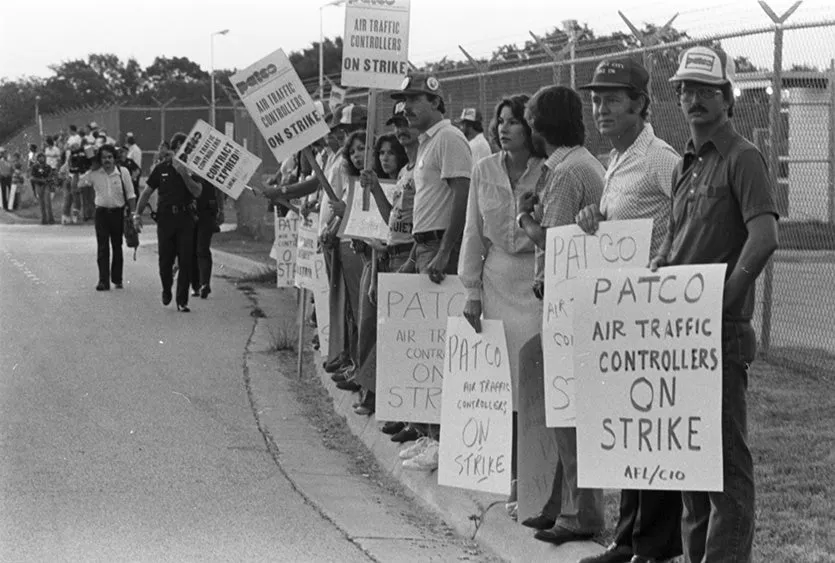 Photo: PATCO strike, via lhrp.georgetown.edu
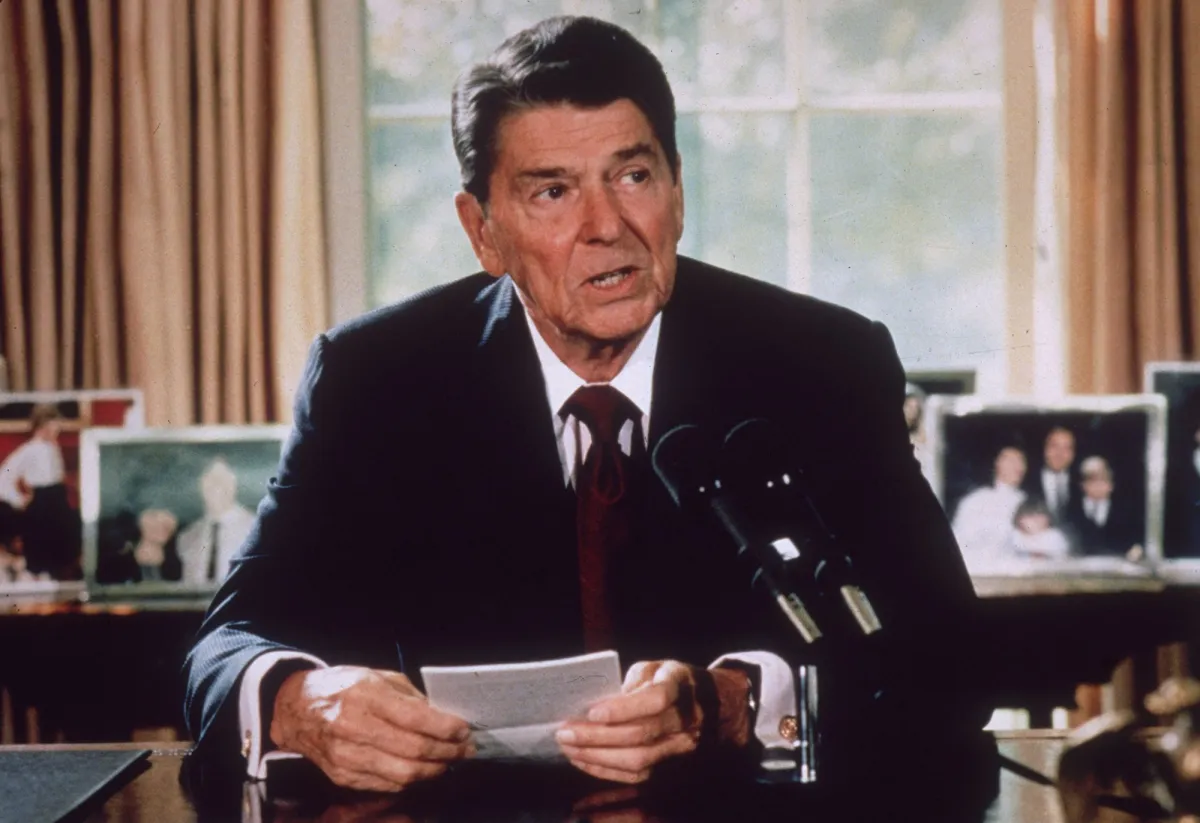 Photo: President Reagan, via www.thoughtco.com
Manufacturing jobs that had once anchored union membership began moving offshore through the 1970s and accelerating through the 1990s. The industries that replaced them — retail, food service, logistics, technology — were largely non-union, and many were structured specifically to avoid the conditions under which unions tend to form. Part-time schedules, contractor classifications, and high turnover rates all make organizing significantly harder.
By 2023, union membership had fallen to around 10 percent of the workforce. In the private sector specifically, it sits closer to 6 percent. The floor that once held up a third of American workers now covers a fraction of them.
What Workers Inherited Instead
The generation that entered the workforce in the 2000s and beyond inherited a very different deal. The defined-benefit pension was largely replaced by the 401(k), which shifts investment risk entirely onto the employee. Health coverage became something negotiated individually, often at significant personal expense. The concept of job security gave way to the language of "flexibility" — a word that, depending on your circumstances, can mean freedom or precarity.
The gig economy took that logic further. Platforms built around independent contractor classifications have created a category of work that looks like employment in every practical sense but carries none of the legal protections that employment once entailed. No overtime. No employer health contribution. No unemployment insurance if the work dries up. The flexibility is real. So is the exposure.
None of this happened by accident. It reflects deliberate choices about how labor markets should be structured and who should bear the risks inherent in economic life. For decades, that risk was shared — between employers, employees, and the broader social contract that unions helped negotiate. The shift moved most of that risk onto individual workers, one industry at a time.
The Part That's Hard to Quantify
There's something beyond the benefits and the wages that gets lost in the numbers. Union membership in its prime years gave ordinary workers a seat at the table — not metaphorically, but literally. Collective bargaining meant that the people doing the work had formal input into the conditions under which they did it. That kind of structural voice is difficult to replace with a suggestion box or an employee satisfaction survey.
Gerald's grandson might be working three part-time jobs right now, none of which offer benefits, all of which can end with a text message. He's not less capable than his grandfather. The architecture around him is just built differently — and for a lot of American workers, the comparison between those two structures is one of the starkest ways to see how much the world of work has actually changed.