The Weekend the Car Taught You Everything: What Was Really Happening in America's Garages
The Weekend the Car Taught You Everything: What Was Really Happening in America's Garages
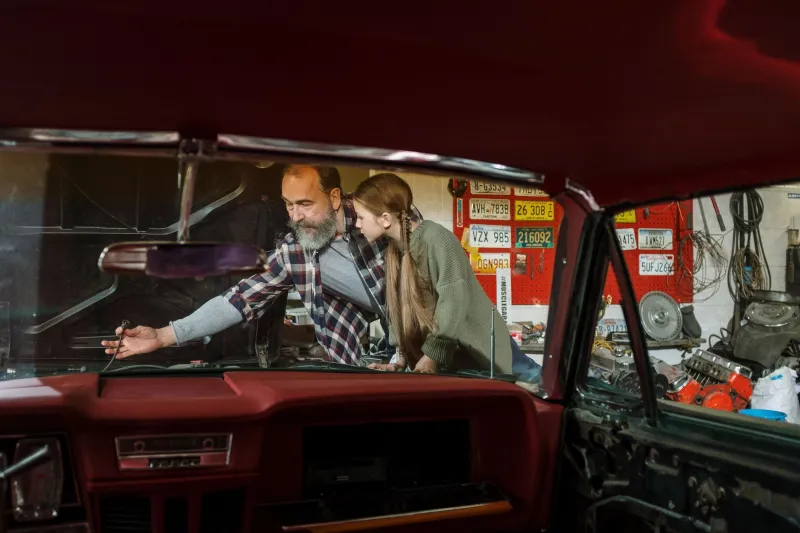
The smell comes back first. Oil, rubber, metal, something faintly chemical that you could never quite name. Then the sound — a radio playing somewhere in the background, a wrench clicking against a bolt, maybe a word you weren't supposed to repeat at school. The garage on a Saturday morning was its own world, and if you were lucky, you were allowed in it.
For a long stretch of American life — roughly from the postwar boom through the early 1990s — the family car was more than transportation. It was a recurring project, a shared puzzle, a reason for two generations to spend time in the same space doing something that actually mattered. The knowledge passed in those garages was practical and specific, but what it carried underneath was something harder to name and harder to replace.
Cars That Wanted to Be Fixed
The vehicles of the 1950s, 60s, and 70s were not sophisticated machines by modern standards, and that was precisely the point. Engines were large, accessible, and built with the assumption that someone other than a factory technician might need to work on them. Carburetors could be cleaned with a rag and some spray. Brake pads could be swapped on a driveway. Spark plugs, air filters, belts, hoses — these were items on a list a reasonably capable person could work through on a weekend afternoon with a basic set of tools and a Chilton manual from the auto parts store.
Ownership came with a kind of mechanical responsibility that has largely vanished. You were expected to know something about how your car worked. Not everything — but enough. Enough to diagnose a rough idle, enough to know when something sounded wrong, enough to change your own oil without a second thought. The car was a machine you lived with, not a service you subscribed to.
And in that environment, the garage became a natural classroom. Fathers taught sons. Sometimes mothers taught daughters. Uncles, neighbors, older brothers — mechanical knowledge flowed through the informal networks of families and communities because it was genuinely useful and because the machines themselves invited participation.
More Than Torque Specs
Anyone who learned to work on cars in that era will tell you the same thing: the lessons weren't really about the car. The car was the occasion. What was actually being transmitted was something broader and more durable.
Problem-solving under uncertainty. When the engine won't turn over and you don't know why, you start eliminating possibilities. You think systematically. You resist the urge to guess randomly and instead work through what you know. That's a cognitive skill, and the garage was where a lot of American men first developed it in a serious way.
Patience with complexity. A repair that should take an hour sometimes takes a Saturday. A bolt that should come loose doesn't. Something unexpected is always hiding behind the thing you already fixed. Learning to stay calm in that situation — to step back, reassess, try again — is a form of emotional education that doesn't show up on any curriculum.
The tolerance for not knowing. In the garage, it was okay to say "I'm not sure" and then go figure it out. That combination — intellectual humility followed by genuine effort — is something a lot of people learn best through physical, hands-on experience. The car provided that experience in abundance.
And underneath all of it, the relationship. Two people, a shared problem, and a few hours of unstructured time. The garage conversation wasn't the focused, intentional kind. It wandered. It paused. It picked back up. But that wandering, unforced quality was often where the real things got said.
What Sealed the Hood
Modern vehicles are engineering marvels, and that's not a small thing. They're dramatically safer, more fuel-efficient, more reliable, and cleaner than anything rolling off assembly lines in 1968. The average car today will travel far more miles with far fewer mechanical interventions than its predecessors. That's a genuine achievement.
But the complexity that makes modern cars so capable also makes them nearly impenetrable to the casual owner. Today's engine bays are dense with sensors, modules, and computer-controlled systems that interact in ways no Chilton manual can fully map. The onboard diagnostic systems that manage engine performance require specialized equipment to read — equipment that, in many cases, only dealerships and certified shops possess.
Right-to-repair has become a political issue in the automotive space, with manufacturers increasingly restricting access to the diagnostic software and proprietary tools needed to service their own vehicles. The car that once invited tinkering now actively resists it. Opening the hood often reveals a plastic cover designed to protect components — and, incidentally, to signal that this is not a space for amateurs.
For the family garage, the effect has been decisive. There simply isn't much a non-professional can do on a modern vehicle without specialized tools and software access. Oil changes remain possible. Wiper blades, sure. But the rich Saturday-morning curriculum of the earlier era has been effectively closed off.
The Gap That Opened
What fills the space the garage used to occupy? It's a genuine question, and not a rhetorical one. The transmission of practical, physical knowledge between generations doesn't disappear just because one vehicle for it closes. It finds other channels — or it doesn't, and something is quietly lost.
YouTube has made some kinds of DIY knowledge more accessible than ever. Woodworking, home repair, cooking — there are excellent resources for people who want to learn hands-on skills. But watching a video alone in your room is a fundamentally different experience from standing next to someone who knows what they're doing and learning through proximity, repetition, and the occasional mistake made in real time.
The garage was never really about the car. It was about time, and trust, and the slow transfer of competence from one person to another. The cars got better. The garages got quieter. And something that happened naturally for generations now has to be intentionally sought out — which means a lot of people never seek it at all.