The Man at the Hardware Store Could Fix Anything — Including Your Confidence
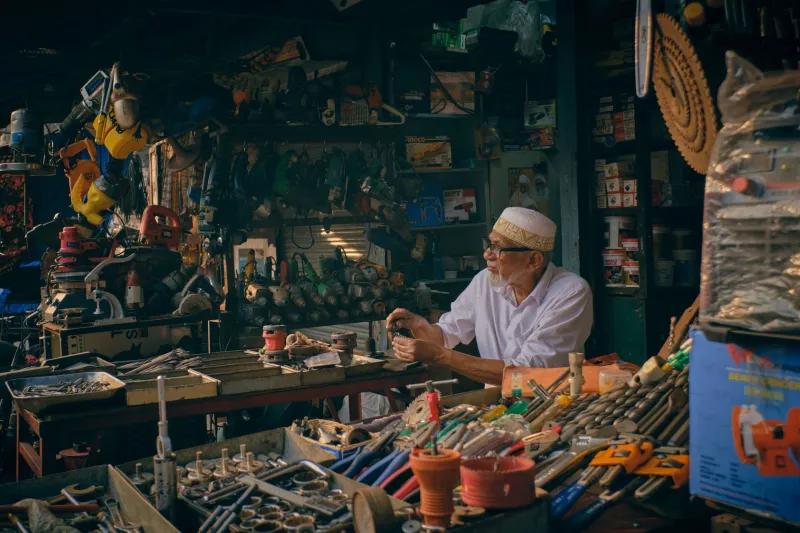
Picture this: It's 1974. You've just bought your first house in a suburb outside Columbus, and the kitchen faucet is dripping in a way that suggests it has opinions about being ignored. You don't know a compression fitting from a ball valve. You've never replaced a washer in your life. Your father-in-law is useless on plumbing. So you drive to the hardware store on Elm Street — the one with the creaky wood floors and the smell of machine oil and sawdust — and you ask the guy behind the counter.
His name is probably Earl. He's been there since before you were born. And within four minutes, he has diagnosed your problem, walked you to the correct aisle, handed you a small paper bag with exactly the parts you need, and explained the repair in terms clear enough that you actually pull it off on the first try. Total cost: eighty-five cents and a brief conversation.
That experience — unremarkable at the time, almost mythological now — was the backbone of American home ownership for most of the twentieth century.
What the Neighborhood Hardware Store Actually Was
The independent hardware store was a different creature from what most Americans shop at today. These were small, dense, sometimes chaotic places where the inventory made no obvious sense to outsiders but perfect sense to the staff who'd organized it over decades. The bins of loose bolts, the wall of hand tools, the dusty boxes of specialty fittings — all of it was curated by people who understood what local homeowners actually needed.
More importantly, the staff knew their product. Not in the way that a big-box employee knows where the power tools are located — but genuinely, deeply, from experience. Many of them had worked trades before settling into retail. Some were retired plumbers, electricians, or carpenters. Others had simply spent thirty years answering questions from homeowners and absorbing everything they heard. They were, in the truest sense of the word, experts.
And they shared that expertise freely. There was no upsell pressure, no commission structure pushing them toward the most expensive option. If a twenty-cent washer could fix your problem, that's what they'd sell you. If a repair was beyond your skill level, they'd tell you that, too, and recommend someone honest to call. The relationship was built on trust because in a small town or a tight neighborhood, trust was the only currency that mattered.
The Big Box Arrives
Home Depot opened its first stores in Atlanta in 1979. Lowe's, which had existed as a regional chain since the 1940s, began its aggressive national expansion in the 1980s. By the 1990s, the big-box model was reshaping retail hardware the way Walmart was reshaping everything else — through sheer scale, low prices, and an inventory so vast it made the neighborhood store look like a toy shop.
The economics were brutal and simple. A local hardware store couldn't compete on price with a chain buying in volumes that dwarfed entire regional markets. One by one, the Earls of the world closed their doors. The National Hardware Show, which had tracked the industry for decades, documented the collapse of thousands of independent retailers through the 1990s and 2000s. Some survived by specializing. Most didn't.
What replaced them was efficient, affordable, and impersonal in a way that took a while to fully register. The big-box stores were enormous — warehouse-scale spaces with tens of thousands of SKUs and staffing models built around stocking shelves rather than answering questions. Employees were often part-time, frequently undertrained, and rarely in a position to walk a nervous first-time homeowner through a weekend project.
The Self-Service Era
The internet partially filled the gap. YouTube, launched in 2005, became an unlikely hardware store counter — a place where skilled tradespeople and enthusiastic amateurs posted step-by-step repair tutorials that anyone could access for free. Today, you can find a video for almost any home repair task imaginable: replacing a toilet wax ring, rewiring a light switch, repointing brick mortar, installing a ceiling fan. The knowledge is there, searchable, and usually pretty good.
Online forums — Reddit's r/DIY community has over five million members — offer something closer to the interactive advice of the old hardware store. You describe your problem, post a photo, and within hours someone who's done it before walks you through the fix. It's democratized expertise in a real way, and it's helped a generation of homeowners tackle projects they might otherwise have paid someone to handle.
The tools themselves have improved, too. Modern power tools are more forgiving of amateur technique. Instructional packaging has gotten better. Products like peel-and-stick tile and snap-together flooring have made certain jobs genuinely accessible to people without trade experience.
The Gap That YouTube Can't Close
But there are things a video can't do. It can't look at your specific situation — the weird angle of your pipes, the age of your electrical panel, the particular quirk of your 1952 plaster walls — and tell you what that means for your project. It can't tell you when to stop and call a professional before you make something worse. It can't read the hesitation in your face and understand that you're in over your head.
The old hardware store clerk provided something that's genuinely hard to replicate digitally: situational judgment. Earl didn't just know how drain assemblies worked in theory. He knew how they worked in the houses on your street, built by the same contractor in the same decade, with the same slightly off-spec plumbing that caused the same three recurring problems. That hyperlocal, experience-based knowledge is almost entirely gone.
There's also something harder to name — a confidence that came from being helped by someone who believed you could do it. Earl handed you that paper bag of parts with the quiet assurance of a man who'd sent a thousand nervous homeowners out the door before you, and most of them had come back to report success. That belief was part of the transaction. It doesn't come through a screen.
What We're Building Without
The big-box era gave Americans access to more products at lower prices than any previous generation of homeowners. That's a genuine improvement, and it shouldn't be dismissed. But it also quietly removed a layer of community infrastructure that served a purpose beyond commerce — a place where knowledge was shared freely, where expertise was local and personal, and where a first-time homeowner could walk in uncertain and walk out capable.
The hardware store wasn't just a store. It was a neighborhood institution. And like a lot of neighborhood institutions, we didn't fully understand what it was until it was already gone.