Pick Up or Don't: What the Telephone Used to Mean Before It Became a Tracking Device
Pick Up or Don't: What the Telephone Used to Mean Before It Became a Tracking Device
Somewhere in the mid-1990s, a small piece of technology showed up on American telephone handsets and quietly rewired the social contract around communication. Caller ID. Two words on a tiny screen that changed, more than anyone predicted, not just how Americans answered the phone but how they thought about being reachable at all.
Before that, answering the telephone was a minor act of faith. The phone rang. You picked it up. And for one beat — before the voice on the other end announced itself — you genuinely did not know who was there. It could be your mother. Your boss. A friend calling to make plans. A wrong number dialing a stranger's house for the third time that week. That small uncertainty was just part of how communication worked, and it shaped American phone culture in ways that are surprisingly hard to recover once you start thinking about them.
The Shared Phone Was a Household Negotiation
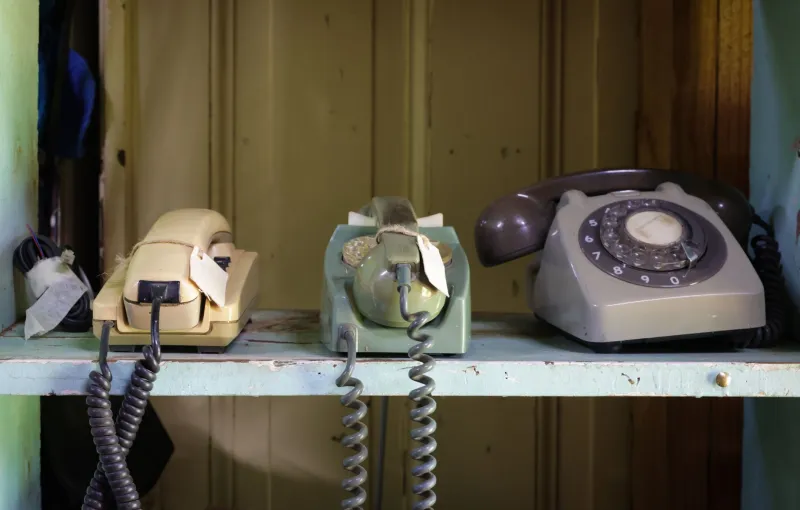
For most families through the 1980s, the telephone was a singular, shared object — one line, one number, mounted to a kitchen wall or sitting on a table in the hallway. It belonged to the household, not to any individual member of it.
This created dynamics that seem almost foreign now. Teenagers negotiated for phone time with parents and siblings. Conversations had natural time limits because someone else might be waiting. If you called a friend and their line was busy, you hung up and tried again later — or you let it go until tomorrow. The busy signal was the era's most honest communication: someone's evening is already spoken for, and it isn't yours.
There was also the matter of who answered. Call a friend's house and their father might pick up. Call a boyfriend and his younger sister might answer and take a message. These intermediary moments — slightly awkward, requiring a few seconds of polite conversation with someone you weren't calling — were minor social exercises in courtesy and patience. They forced a kind of deliberateness that has no modern equivalent.
The Answering Machine Changed the First Rule
The answering machine arrived in American homes through the late 1970s and 1980s and introduced the first significant shift: you could now choose, in real time, whether to pick up or let a call go to the tape. This was genuinely novel. For the first time, Americans could screen — could hear the caller's voice during the outgoing message and decide, mid-ring, whether they felt like talking.
This was considered, at the time, a little rude. The etiquette writers weighed in. There were debates about whether screening was acceptable or antisocial. People felt vaguely guilty doing it. The expectation that a ringing phone should be answered was deeply ingrained, and the machine disrupted it just enough to cause cultural friction.
Looking back, the answering machine was the first crack in the assumption that being reachable was an obligation rather than a choice. But the crack was small. The machine recorded your voice. You still had to call back. The relationship between caller and recipient was still roughly symmetrical — both were working within the same system, both understood the same norms.
When Caller ID Arrived, Something Shifted
Caller ID changed the dynamic in a more fundamental way. Now you didn't just know a call had come in — you knew exactly who had tried to reach you and when. The mystery was gone. And with it went something harder to name: a certain baseline openness to contact that had previously been baked into the act of answering.
Once you could see who was calling, every decision to pick up or not became a deliberate choice rather than a default. And once every decision was deliberate, the social arithmetic around phone calls got more complicated. Not answering a call from someone you'd seen on caller ID sent a message. Calling back too quickly suggested you'd been available all along. Calling back too slowly suggested avoidance. The phone call, once a fairly uncomplicated exchange, became something you could overthink.
This wasn't entirely caller ID's fault. The smartphone era amplified everything. When your phone is also your camera, your map, your wallet, and your primary entertainment device, it is always in your hand — which means every call you don't answer is a call you visibly, consciously declined. The modern American relationship with the phone call has become one of mutual low-grade anxiety: nobody wants to receive an unexpected call, and nobody wants to be the person making one without texting first to ask if it's okay.
The Paradox of Total Transparency
Here's the strange outcome of all this visibility: Americans now communicate more than ever and talk less than ever. Text messages, emails, and social media notifications flow constantly. But the actual phone call — the synchronous, voice-to-voice conversation that was once the primary mode of remote human contact — has become a source of mild dread for a significant portion of the population, particularly younger adults.
Studies and surveys have consistently found that many people under forty prefer almost any other communication format to a live phone call. The call feels intrusive. Unscheduled. Demanding of immediate, unscripted response. The very things that once made phone calls feel human — the spontaneity, the real-time negotiation, the slight vulnerability of not knowing exactly what was coming — are now the things that make them feel threatening.
The landline era, for all its limitations, had a kind of built-in privacy that didn't require anyone to defend or explain it. When you weren't home, you weren't reachable. When the line was busy, it was busy. When you didn't pick up, the caller had no way of knowing whether you were there or not. These weren't evasions — they were just the natural boundaries of the technology, and they gave people room to be unavailable without it meaning anything.
What Got Lost in the Upgrade
The telephone used to require something from both parties: a willingness to show up to a conversation without a script, to hear a voice you weren't expecting, to navigate a few seconds of genuine social uncertainty. That friction wasn't a bug. It was a feature — a small, regular exercise in being present with another person in real time.
We traded it for the ability to see exactly who's calling, respond on our own schedule, and avoid the phone entirely if we feel like it. Those are real conveniences. But the phone call that used to just happen — the one that started with a ring and a voice and no preview of what was coming — carried a kind of human warmth that the read receipt and the typing indicator haven't quite managed to replace.