The Doctor Will See You Now — For About Eight Minutes on a Screen
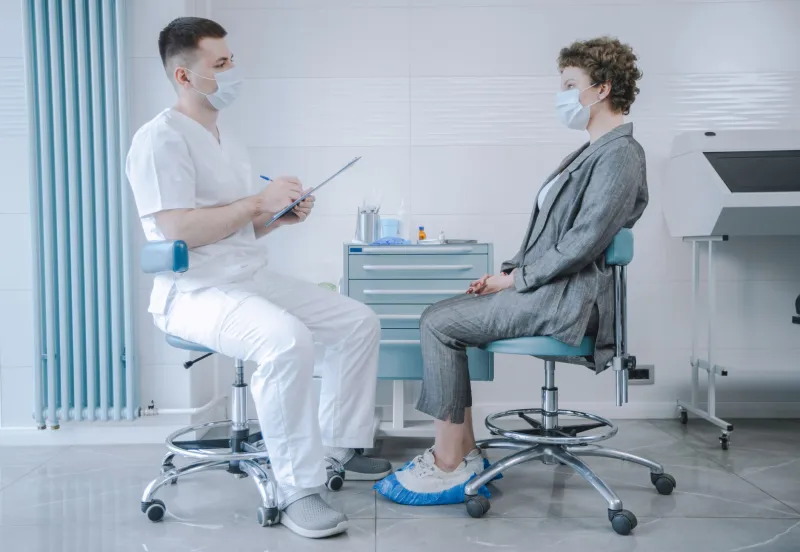
There's a particular smell that belongs to old-fashioned doctor's offices. Antiseptic, maybe, with something underneath it — old magazines, carpet, the faint trace of coffee from the receptionist's desk. If you grew up before the late 1990s, you know it. And if you're honest, there's something almost comforting about the memory, even if the waiting itself was anything but comfortable.
American medicine has changed more dramatically in the last thirty years than in the three decades before that. And yet somehow, the experience of being a patient has gotten both faster and more impersonal at the same time — a strange paradox that says a lot about what we've optimized for and what we've quietly set aside.
The Long Wait and the Long Relationship
In the mid-twentieth century, seeing a doctor was an event. You called the office, often spoke to the doctor's wife or a receptionist who'd been there since the practice opened, and made an appointment for sometime next week — or maybe the week after. When the day arrived, you drove to a small office, often in a converted house or a modest medical building, and you waited. Sometimes for twenty minutes. Sometimes for over an hour.
But here's what made that wait different from what we experience today: the person you were waiting for actually knew you. Family physicians in that era often served the same patients for decades. They knew your medical history without opening a file. They knew your mother had high blood pressure and your father had bad knees. They knew you were anxious about needles and that you tended to minimize your symptoms.
The appointment itself was unhurried by today's standards. The doctor asked questions. He listened — not just to your answers, but to your breathing, your tone, the things you hesitated before saying. The physical examination was thorough because there wasn't a CT scanner down the hall to compensate for a quick once-over. Diagnosis was a craft built on observation, experience, and time.
You left with a handwritten prescription on a small pad, instructions you probably didn't fully follow, and the understanding that if things got worse, you'd call and he'd pick up.
The Revolution Arrives
The transformation of American medicine didn't happen all at once. Managed care in the 1990s began squeezing appointment times. Electronic health records, introduced broadly in the 2000s, promised efficiency but often meant doctors spent half the appointment looking at a screen instead of a patient. Consolidation turned independent practices into health system outposts, where physicians cycled through patients like a production line and saw your chart for the first time thirty seconds before walking through the door.
Then came the internet, and everything changed again — this time from the patient's side.
WebMD launched in 1996. By the mid-2000s, Americans were arriving at appointments with printouts, self-diagnoses, and lists of questions generated by search engines. The information gap between doctor and patient narrowed, which was genuinely empowering in some ways and genuinely maddening in others. Physicians began spending precious appointment minutes undoing the conclusions patients had drawn from three hours of late-night Googling.
Then COVID-19 arrived in 2020 and compressed a decade of telehealth adoption into about six weeks.
The Ten-Minute Video Call
Today, an enormous portion of American medical care happens on a screen. Telehealth platforms connect patients to physicians — sometimes their own, often a stranger — in minutes rather than days. You describe your symptoms. The doctor looks at you through a camera. A prescription appears in your pharmacy app before the call ends. The whole encounter might last eight minutes.
For certain situations, this is genuinely remarkable. A parent in rural Montana who used to drive two hours to see a specialist can now do it from the kitchen table. A working parent who can't take a half-day off for a routine follow-up can squeeze in a call during lunch. Prescription refills, minor infections, mental health check-ins — telehealth handles these efficiently and without the logistical burden that kept many Americans from seeking care at all.
The technology has also created new layers of information. Wearable devices track your heart rate, sleep patterns, and blood oxygen continuously. Patient portals give you access to your own lab results, sometimes before your doctor has reviewed them. Health apps log symptoms over time, creating data sets that didn't exist a generation ago. In theory, a physician today has more information about a patient than any doctor in history.
The Thing the Camera Can't Do
And yet. There are things a video call simply cannot accomplish. A doctor cannot palpate your abdomen through a screen. She cannot hear the specific quality of a cough, feel the texture of a lymph node, or notice that you're holding yourself differently than you did six months ago. The physical examination — the hands-on, in-person, look-you-in-the-eye examination — is still, in many cases, irreplaceable.
More than that, the relationship is gone. When your doctor is whoever happens to be available on the telehealth platform at 2 PM on a Thursday, there's no continuity, no history, no accumulated understanding of who you are as a patient. Every encounter starts from scratch. Every symptom is evaluated without context.
Patients feel it. Studies consistently show that Americans trust their own doctor far more than they trust the healthcare system in general. The distinction matters: trust in a specific person, built over years of appointments, is different from trust in a platform. One is a relationship. The other is a transaction.
Progress and Its Price
American medicine in 2024 can do things that would have seemed like science fiction to a physician in 1965. Cancers are caught earlier. Surgeries that once required weeks of recovery take a few hours. Medications exist for conditions that were once death sentences. The progress is real and it's staggering.
But the waiting room — that slow, slightly tedious, fundamentally human ritual — carried something that efficiency can't replicate. It was time. Time for the doctor to know you, time for you to feel known, time for the relationship between patient and physician to become something more than a transaction.
We traded that time for speed, and mostly we got what we paid for. Whether we got what we needed is a different question.