Cake Mix, Crepe Paper, and Pure Joy: Before Birthdays Became Brand Activations
Here's a birthday party from 1978. Six kids from the neighborhood show up at 2 p.m. on a Saturday. There are crepe paper streamers taped to the doorframe. A sheet cake with white frosting and the birthday kid's name written in blue gel sits on the kitchen table. Someone's mom has made a batch of fruit punch. There are balloons — maybe eight of them, tied to a chair. Pin the tail on the donkey happens. Someone cries briefly. Everyone eats cake. By 4 p.m., the kids have scattered back to their yards.
Total cost: maybe twelve dollars. Total memories retained: somewhere between everything and forever.
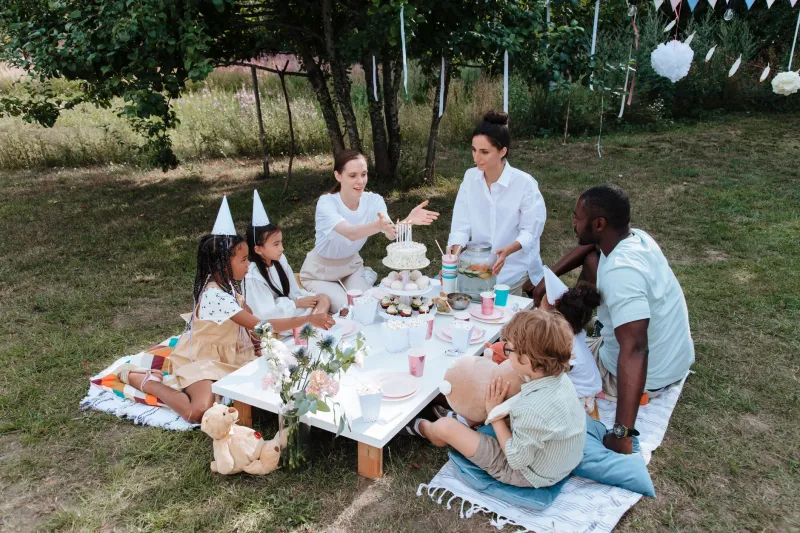
Now here's a birthday party from 2024. Venue booked six weeks in advance. Custom invitations ordered online. A themed backdrop for photos. A professional cake from a specialty bakery, decorated to match the theme. Favor bags assembled the night before. A content plan, essentially, even if the parents wouldn't call it that. Total cost: somewhere between $400 and $4,000 depending on the zip code and the social media ambitions involved.
Something happened between those two parties. It's worth figuring out what.
The Simplicity Wasn't Accidental
The low-key birthday party of previous decades wasn't the result of parents caring less. It was the result of a completely different set of assumptions about what a celebration was supposed to accomplish.
The purpose was joy. Specifically, the child's joy. And children, it turns out, are remarkably easy to delight. A cake with their name on it. Friends running around the backyard. A present or two wrapped in Sunday comics. The experience of being the center of attention for an afternoon was, in itself, the gift.
Mothers baked the cakes themselves — not because they were hobbyists, but because that was simply what you did. Betty Crocker and Duncan Hines made it accessible. The cake didn't need to be architectural. It needed to be there, with candles, and it needed to be chocolate if that's what the kid wanted.
The party was also, crucially, for the neighborhood. You invited the kids on your block, the kids from your class, the cousins if they were nearby. The guest list was determined by geography and relationship, not by the optics of who would look good in the photos.
There were no photos. Or rather, there might be one roll of film that produced twelve usable images, most of them slightly blurry, that would sit in an envelope in a drawer for thirty years and surface at a graduation party as evidence of how small everyone used to be.
When Did It Start to Shift?
The escalation was gradual, and it didn't have a single cause.
The party supply industry expanded enormously through the 1980s and 1990s, introducing themed plates, cups, and napkins tied to whatever movie or cartoon was currently dominating a child's imagination. The themed party became standard, then expected. Party City opened its first store in 1986 and eventually operated nearly a thousand locations across the country — a physical monument to the industrialization of celebration.
At the same time, the competitive element entered. Parents began comparing parties the way they compared school supplies or Halloween costumes. The bar moved. What had been adequate became plain. What had been plain became sad.
And then the internet arrived, and Pinterest arrived, and Instagram arrived, and suddenly every parent had access to an endless gallery of other people's most elaborate moments, stripped of context and cost and the three hours of prep work behind them. The party that used to exist for the child now also existed for the feed.
The Performance Problem
Here's the thing about optimizing a birthday party for documentation: the things that photograph well aren't always the things that feel good.
A balloon arch is spectacular in a photo. It takes about ninety minutes to assemble and costs $80 in supplies, and kids walk past it to get to the cake. A custom fondant cake with hand-painted details looks extraordinary on Instagram. Children, given a choice, would almost universally prefer the sheet cake with the gel frosting that tastes like childhood.
The gap between what looks impressive and what is actually fun has grown into a canyon. And somewhere in that canyon, the actual child — the one whose birthday it theoretically is — has gotten a little lost.
Research on childhood memory is pretty consistent on this point: kids don't remember elaborate. They remember specific. They remember the moment their friend fell off the chair during musical chairs. They remember their dad doing a terrible magic trick. They remember the dog eating the corner of the cake before anyone noticed. These are not Instagram moments. They are life.
What We're Really Buying
The modern elaborate birthday party is, at least in part, a product of anxiety. Not malice, not vanity (or not only vanity) — anxiety. The fear that your child will feel less-than if their party doesn't measure up. The fear that other parents will judge. The fear that in twenty years your kid will remember a sad little gathering while their friends remember a blow-out.
None of these fears are entirely irrational. But they're also not entirely grounded in how children actually experience the world.
What children remember is feeling celebrated. Feeling seen. Feeling like the people who love them showed up and made something happen. A homemade cake made by a parent who stayed up too late getting the frosting right communicates love in a language children understand perfectly. A cake ordered from a specialty bakery and matched to a color palette communicates something, too — but it's a slightly different message.
The $8 Party's Secret
There's a reason people in their forties and fifties talk about their childhood birthday parties with a warmth that seems disproportionate to what actually happened at them. Nothing extraordinary occurred. The crepe paper wasn't even hung very straight.
But the whole thing was made by hand, by people who loved them, for the specific purpose of making them feel special for one afternoon. There was no subtext. No audience. No content strategy.
Just cake, and friends, and a kid who got to be the main character for a few hours.
That's a hard thing to replicate with a balloon arch. But it's not hard to replicate at all, actually — if you're willing to let go of the performance and just throw the party.