The Front Yard Used to Be a Story. Now It's a Listing Photo.
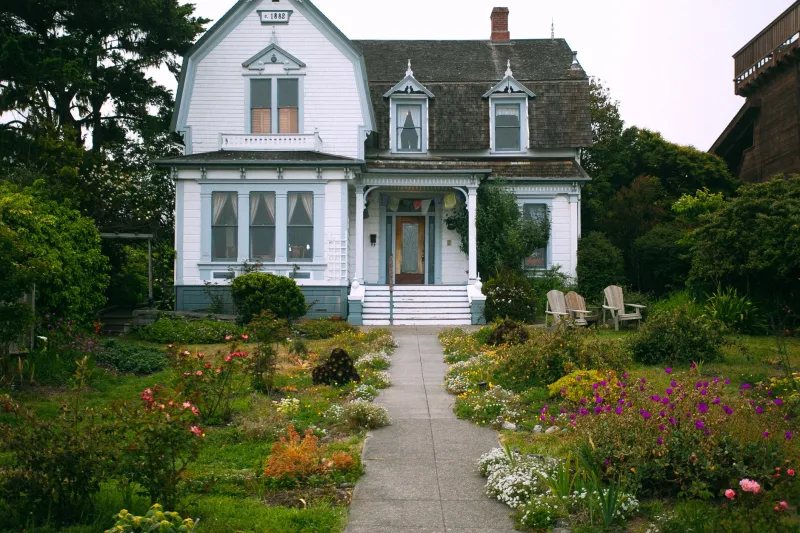
Drive through almost any American suburb built in the last thirty years and the yards start to blur together — same sod, same mulch, same anonymous shrubs trimmed to identical heights arranged symmetrically around a two-car garage. It's tidy. It's inoffensive. It photographs well.
It tells you absolutely nothing about who lives there.
That wasn't always the case. For most of American residential history, a front yard was a kind of autobiography. You could learn a lot about a family just by slowing down on their street.
When Yards Were Actually Lived In
Go back fifty or sixty years and the American yard was a working space. Not just a decorative one. Vegetable gardens occupied side lots and backyard corners, sometimes sprawling right up to the front walk. Clotheslines ran between poles or from the house to a tree, and laundry hung in public view without apology — it was practical, not embarrassing.
Tool sheds leaned against garages. Compost piles sat in corners. A half-rebuilt engine might occupy a driveway on a Saturday afternoon, surrounded by a man's legs sticking out from underneath a car. Kids' bikes lay on their sides in the grass because kids had been on them ten minutes ago and would be on them again in ten minutes more.
These yards were not curated. They were inhabited. They reflected the actual lives of the people inside — what they grew, what they fixed, what they built, what they valued. Neighbors could tell you were canning tomatoes from the smell drifting through the screen door. They could see you were working on the fence. They knew you had a new baby because the stroller was on the porch.
There was a transparency to it. Not invasive — just honest.
The Porch as Social Infrastructure
The front porch was the hinge between the private world inside and the public world of the street. People actually sat on them. In the evenings, in the summer, families moved outside. You waved to neighbors walking dogs. You called across the lawn to the Hendersons. The porch was where information traveled — who was sick, who had a new job, whose kid had just graduated.
This wasn't nostalgia-bait. It was functional community infrastructure, and it required the yard to be a place of presence rather than performance.
The shift away from it was gradual and had multiple causes. Air conditioning made the porch optional. Television made the living room magnetic. Longer commutes shrank the evening hours. And then, slowly, the front yard began its transformation from a lived-in space into something else entirely.
HOAs and the Aesthetics of Conformity
Homeowners associations began spreading through American suburbs in the 1960s and accelerated dramatically through the 1980s and 1990s. By 2020, an estimated 74 million Americans — roughly one in four — lived under some form of HOA governance. The rules varied, but the aesthetic vision was consistent: uniformity, tidiness, and the suppression of anything that might signal individuality.
Clotheswires were banned. Vegetable gardens in front yards became controversial (and in many associations, outright prohibited). Sheds required approval. Paint colors required approval. The height of your grass required compliance. The logic was always the same: property values.
And here's the uncomfortable truth — it worked, in the narrow sense. Neighborhoods with strict HOAs did tend to hold their values better in certain market conditions. The house as investment vehicle demanded the yard as controlled variable. Anything that deviated from the expected visual norm introduced risk, and risk was the enemy of resale.
The problem is that optimizing a neighborhood for resale value is a fundamentally different project than optimizing it for living.
What the Listing Photo Replaced
The rise of real estate platforms like Zillow and Redfin completed a transformation that HOAs had started. Every home became perpetually pre-staged for its eventual sale. Curb appeal stopped being a casual compliment and became a strategic priority. Front yards were now photographed from the street and evaluated by strangers in other states who would never smell the neighbor's roses or hear the kids two doors down.
The vegetable garden that once signaled self-sufficiency now read as clutter. The clothesline that once represented thrift now suggested poverty. The project car in the driveway — the one that taught a generation of teenagers how engines worked — became a liability. Everything that made a yard personal became, in the logic of the market, a problem to be solved.
We didn't just change what yards looked like. We changed what they were for.
The Quiet Cost
What gets lost when yards become interchangeable? More than aesthetics.
The vegetable garden that ran along the fence taught kids where food came from. The tool shed was a classroom. The front porch was a news network. The visible projects — the fence being painted, the car being rebuilt, the garden being turned over in spring — announced to the neighborhood that people were here, working, living, making something.
There's a reason that neighborhoods with active front porches and visible human activity tend to have lower rates of certain kinds of crime. Presence deters. But presence requires that the yard be a place where presence is welcome, not a patch of controlled sod designed to be seen from a car at thirty miles an hour.
The before-and-after here isn't hard to see. The question is whether we actually prefer the after, or whether we've just stopped asking.