Sit Down, We'll Call You: What Disappeared When Doctor's Offices Got Fast
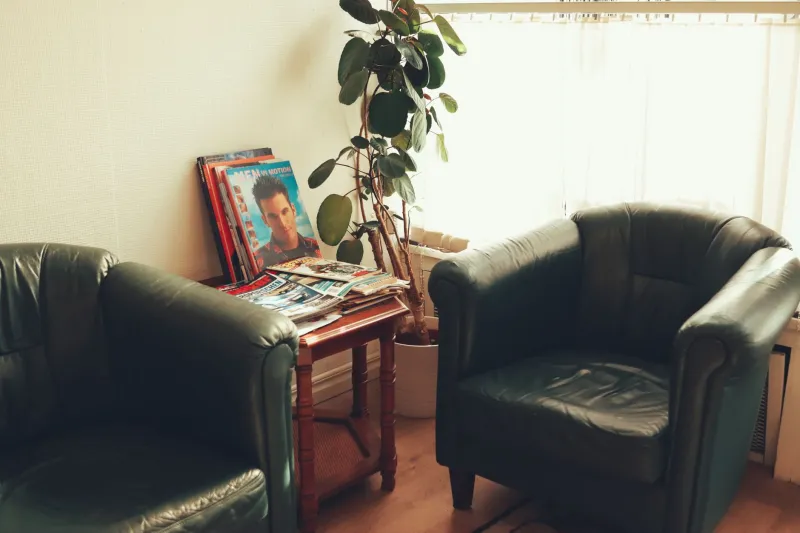
There used to be an unspoken social contract embedded in the American doctor's waiting room. You showed up, you took a number (sometimes literally), and you waited. Nobody was in a hurry. Nobody expected otherwise. The chairs were sturdy and slightly uncomfortable, the magazines were six months old, and the woman next to you had already been there forty-five minutes and was happy to tell you exactly why.
That world is mostly gone now. And it's worth asking what left with it.
The Room That Had Its Own Rhythm
For most of the twentieth century, the waiting room was less a holding area and more a neighborhood gathering point. General practitioners served tight geographic communities — the same families, sometimes across generations. You might sit across from your kid's teacher, your mail carrier, or the guy who ran the hardware store on Elm Street. Nobody wanted to be there, exactly, but everyone understood the shared experience of it.
The wait itself was long by today's standards. An hour wasn't unusual. Two hours wasn't unheard of. Doctors ran on something closer to intuition than a calendar — they gave each patient however long they needed, which meant the schedule was always running behind, which meant the waiting room was always full. It was inefficient in every measurable way. It was also oddly human.
Kids played with the same battered wooden bead maze that had been bolted to a table since the Eisenhower administration. Adults read. Talked. Dozed. Somewhere in that slow, shared stillness, anxiety had a chance to settle. By the time your name was called, you'd already processed some of whatever had brought you in.
The Clipboard Era
Things started shifting in the 1980s and accelerated through the 1990s. Managed care arrived and brought with it the logic of throughput. Appointments were formalized, then compressed. The goal became seeing more patients per hour, not necessarily knowing each one better. The clipboard with its stack of duplicate forms became the symbol of a system reorganizing itself around documentation rather than conversation.
Still, even into the early 2000s, most waiting rooms retained their character. There was a fish tank if you were lucky. A stack of People magazines from earlier in the year. A receptionist who knew your last name and your mother's last name and probably asked after your kids by name.
The room still functioned as a kind of buffer zone — a place between the outside world and the clinical one, where you had a few minutes to collect yourself before the doctor walked in.
Now Boarding: Exam Room Three
Today's medical office experience has been engineered within an inch of its life. You check in on a tablet or through a patient portal before you even arrive. Your insurance is pre-verified. Your co-pay is auto-charged. You might receive a text when the doctor is ready, like a table at a restaurant.
The waiting room still exists, but it's been stripped of its communal energy. Everyone stares at a phone. Interaction is minimal. The goal — on both sides of the glass partition — is to move things along.
Once you're called back, the efficiency intensifies. A medical assistant takes your vitals in under three minutes. The doctor appears, sometimes within moments, and the appointment unfolds on a tight clock. Fifteen minutes is standard. Some practices have pushed it to ten. There's a screen in the room now, and the physician's eyes move between you and it with roughly equal frequency.
Nobody's complaining about the wait time. That's a genuine improvement. But something else has been quietly lost in the optimization.
What the Wait Was Actually Doing
Here's the thing about sitting in a waiting room for an hour: it gave you time to think about what you were going to say. People arrived with vague symptoms and left with clearer language for them, partly because they'd been sitting quietly long enough to organize their thoughts. The wait was, in an unintentional way, part of the diagnostic process.
It also created incidental community. You learned things in those rooms. An older woman mentioned a specialist her husband had seen. Someone recommended a pharmacy across town that was better about refills. A stranger told you, unprompted, that the same thing had happened to her daughter and she'd turned out fine. That kind of informal knowledge-sharing doesn't happen when everyone's staring at Instagram for twelve minutes before being called back.
And there was something to be said for the receptionist who remembered you. Who noticed you'd lost weight, or asked how your surgery went. Who connected the name on the chart to the actual person. That relationship took years to build and was one of the first things to disappear when practices scaled up and front-desk staff turned over constantly.
The Price of Moving Fast
None of this is an argument against efficiency. Nobody wants to sit in a waiting room for two hours when they're running a fever. The old system had real problems — it was chaotic, it didn't respect patients' time, and it often reflected a paternalistic model where the doctor's schedule mattered more than anyone else's.
But the new system has its own blind spots. Patients who feel rushed don't ask the questions they came in to ask. Doctors who are watching the clock miss the thing the patient almost mentioned. The digital check-in can't read body language. The patient portal doesn't catch the hesitation before someone describes a symptom.
We traded community for convenience, and we got a pretty good deal on the convenience side. The community side is harder to quantify, which is probably why nobody put up much of a fight when it disappeared.
Somewhere between the two-hour wait and the ten-minute appointment is a version of medical care that actually has time for the patient. We haven't quite found it yet.